

When Is a Car Considered Totaled in Phoenix, Arizona?
January 15, 2026 – James Flynn, Esq and Riah Greathouse, Esq
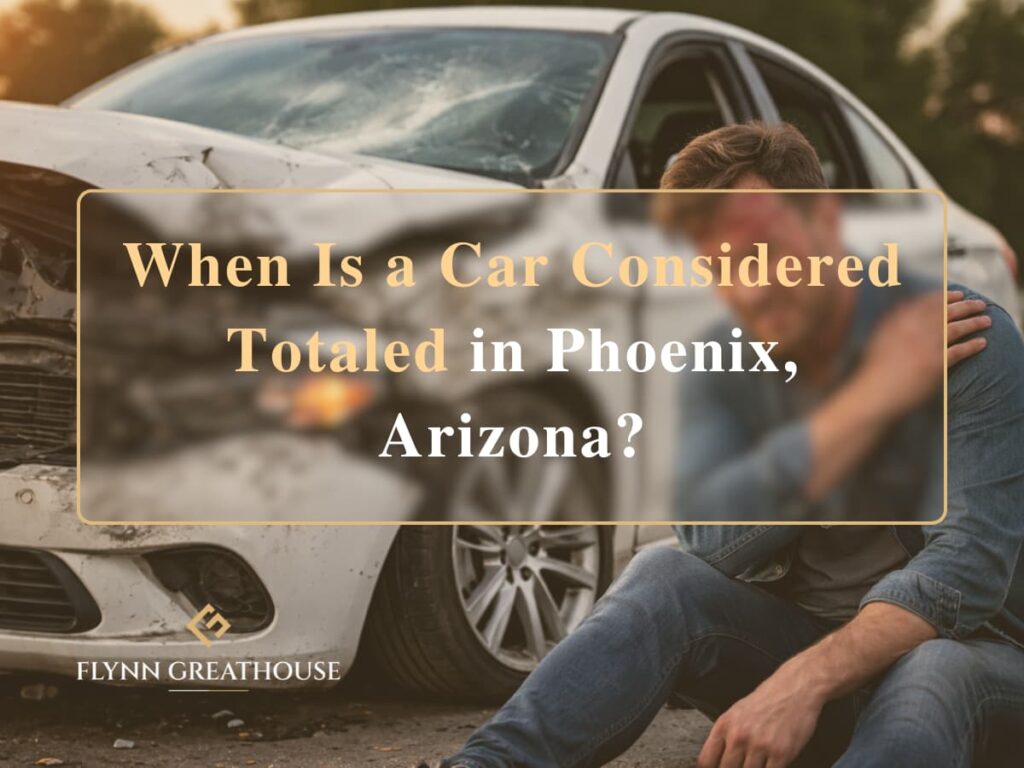
Your car is more than transportation. It’s how you get to work, pick up groceries, take your dog to the vet, or get across Phoenix without thinking twice. For most people, their vehicle is one of the biggest purchases they make, second only to housing. When your car is totaled in a Phoenix car accident, the disruption is practical, emotional, and expensive all at once.
One of the most frequent questions asked online after a Phoenix accident is, “when is a car considered totaled?” You might look at the crumpled metal and wonder how the damage is assessed, or you may be surprised when an insurance company declares a vehicle a total loss even when the damage looks manageable. Dealing with insurance companies typically involves complex formulas rather than a simple visual inspection. If you have suffered injuries and are managing medical bills alongside property damage, the situation feels even more overwhelming. As a Phoenix injury lawyer, I see the same totaled car shock play out in this city again and again. So in this blog, I break down how Arizona defines a total loss, how insurers calculate vehicle value, and the options you have if the numbers don’t add up.
The Total Loss Formula in Arizona
In Arizona, there is no statute that says a vehicle is automatically totaled once repair costs reach a certain percentage of its value. Instead, insurers use a financial standard known as the Total Loss Formula. This method helps determine whether repairing a vehicle makes economic sense based on its value right before the crash.
The basic calculation works like this:
Cost of Repairs + Salvage Value > Actual Cash Value (ACV)
- Actual Cash Value (ACV) is what your car was worth in the local market immediately before the collision.
- Salvage Value is what the insurer could reasonably receive by selling the damaged vehicle for parts or scrap.
- Cost of Repairs reflects the insurer’s estimate to restore the car to its pre-accident condition.
If the combined repair estimate and salvage value meet or exceed the ACV, the insurer will generally classify the vehicle as a total loss.
This formula helps explain why an older vehicle with a lower ACV can be totaled after what looks like a minor collision, while a newer vehicle with higher value may be repaired instead. The specific trim level, mileage, condition, and comparable sales in the Phoenix area all influence how the Total Loss Formula applies to your case.

How Insurance Companies Calculate Actual Cash Value
Disputes over vehicle value are common in personal injury cases that include property damage. Insurers don’t base their valuation on what you originally paid for the car, or what a new model costs today. They focus on the local market price for a comparable vehicle in and around Phoenix.
To determine ACV, insurance companies typically pull data from third-party valuation systems and regional sales. The factors they check include:
- Year, make, model, and trim level
- Mileage shown on the odometer at the time of the crash
- Interior and exterior condition right before the collision
- Documented upgrades that were listed in your policy
- Recent sales or active listings for similar vehicles in the Phoenix area
- Maintenance records, when available, that reflect condition
Most insurers lean heavily on valuation software such as CCC One, Mitchell, or Audatex, paired with comparisons to dealer and private-party sales in the Phoenix market. If you believe the insurer’s valuation is too low, you can submit evidence that supports your position. Useful examples include:
- Receipts for major repairs or upgrades completed before the crash
- Photos showing the car’s condition before the accident
- Current listings for the same model, trim, mileage range, and condition in the Phoenix area
- Independent appraisal reports
Arizona law allows you to dispute the insurer’s ACV assessment by providing your own documentation. A car accident lawyer can assist in organizing evidence and preparing a valuation challenge, especially when insurers rely on low estimates to reduce what they pay.
The Impact of Comparative Negligence on Your Payout
Arizona follows a legal doctrine known as pure comparative negligence under A.R.S. § 12-2506, which determines how compensation is allocated when more than one party shares fault for a motor vehicle accident. Under this rule, you can seek compensation even if you are partially at fault.
Under pure comparative negligence, your payout is reduced by your percentage of fault. For example, if your totaled car’s value is determined to be $20,000 but you are found 20 percent at fault, your compensation for that property loss would be reduced to $16,000.
Insurers often refer to the accident report, witness statements, and other documentation to assign percentages of fault. They may argue that claimants share fault as a way to reduce the amount they pay on both property damage and personal injury compensation.
Disputes over fault and comparative negligence can directly affect the amount for which you may be eligible for compensation across various factors:
- Actual Cash Value and total loss settlement
- Reimbursement for medical expenses
- Compensation for lost wages and physical pain
If you disagree with the fault percentages assigned by an insurer, you may present evidence such as photos, witness testimony, or expert analysis of the accident to support your position. A Phoenix injury attorney can help review the facts of the crash, the accident report, and other evidence to support your personal injury claim under Arizona law.

Sales Tax and Registration Fees in Arizona Total Loss Claims
Taxes and transfer fees become part of replacing your car after an accident. You’re not only losing the vehicle; you’re taking on the added cost of putting another one on the road. Arizona addresses this through the Unfair Claims Settlement Practices regulation. Arizona Administrative Code R20-6-801(H)(1)(b) requires insurers settling a first-party total loss claim to choose one of the following:
- Offer a replacement automobile that is comparable in value and condition including all applicable taxes, license fees, and title transfer fees, or
- Provide a cash settlement that includes the applicable taxes, license fees, and title transfer fees tied to obtaining a comparable replacement vehicle.
This rule specifically governs first-party settlements. These are claims filed with your own insurer. If the insurer leaves taxes or transfer fees out of the offer, that omission can become the basis for a regulatory complaint through the Arizona Department of Insurance and Financial Institutions (DIFI), which oversees insurance conduct in Phoenix personal injury and vehicle accident claims.
When you’re reviewing the insurer’s offer, be aware of these reimbursable items:
- Sales tax required to purchase a comparable replacement vehicle
- Arizona title transfer fees and license fees
- Registration costs tied to placing a comparable vehicle back on the road
- Costs incident to transferring evidence of ownership for a comparable automobile
Arizona law does not require insurers to pay taxes and fees in a separate check. They may include those numbers directly in the settlement offer or the comparable replacement vehicle valuation, depending on how the policy handles ACV settlements.
If you believe taxes or transfer fees were left out of your offer, you can request a breakdown showing what was included, provide receipts or market comparisons for similar vehicles, and review the insurer’s conduct under Arizona’s administrative regulations for total loss settlement practices.
What Happens if You Owe More Than the Car Is Worth?

It’s a stressful reality for many Phoenix drivers that they have “negative equity” in their vehicles. This happens when the balance on your car loan is higher than the Actual Cash Value of the car. If your car is totaled, the insurance company only owes the ACV, not the balance of your loan.
If you owe $25,000 on a truck that is only worth $20,000, you’re still responsible for that $5,000 gap after the insurance check is sent to the lender. This is where GAP insurance can matter. If you have this coverage, it may cover the difference between the ACV and the loan balance, depending on your policy or contract terms. Without it, you might find yourself still making payments on a car that has already been crushed for scrap.
If you’re in this situation, an auto accident attorney can review your policy and the liability insurance of the at-fault party to see if there are other avenues available to pursue compensation for your losses.
The Role of the Accident Report
The accident report filed by Phoenix law enforcement is one of the most important documents in your case. It includes the officer’s observations, witness statements, and often a preliminary determination of fault. Insurers rely heavily on this report when deciding whether to accept liability.
If the report contains errors, it can affect your ability to recover compensation. A personal injury attorney knows how to examine these reports for inaccuracies and may coordinate accident reconstruction analysis when the report conflicts with the facts. A fair settlement often depends on having a complete and accurate record of the wrongful act that led to the crash.

Arizona Title Laws for Totaled Vehicles
Once a car is declared a total loss, Arizona law requires specific steps for the title. Under A.R.S. § 28-2091 and related provisions, a vehicle acquired by an insurance company following a total loss settlement must be issued a Salvage Certificate of Title or a Nonrepairable Vehicle Certificate of Title.
- Salvage Title: Branded for vehicles that are “uneconomical to repair.” These can be rebuilt.
- Nonrepairable Certificate: Branded for vehicles that have no resale value except as a source of parts or scrap metal. These vehicles cannot be rebuilt or legally returned to the road.
If you choose to keep a salvage vehicle, it cannot be driven legally until it passes a Level III inspection by the Arizona Department of Transportation (ADOT). This is the most comprehensive inspection level, and is necessary to verify all major component parts work and make sure the vehicle is equipped for highway use.
Managing Injuries and Property Damage
While the loss of your vehicle is an immediate crisis, it often happens alongside the discovery of serious injuries. In many cases, the property damage claim is settled long before the personal injury claim. This is because it takes time to understand the full extent of medical expenses and the long-term impact of injuries like spinal cord injuries or traumatic brain injuries.
As you move through the claims process, you may face:
- Medical Bills: Costs from the emergency room, diagnostic tests, and surgeries.
- Physical Therapy: Ongoing sessions to regain mobility after severe injuries.
- Lost Wages: Income you missed because you were unable to work during your recovery.
- Emotional Distress: The mental health impact of a motor vehicle crash, including anxiety or PTSD.
A Phoenix personal injury lawyer can represent you in the overlap of property and bodily harm claims. They handle filing personal injury claims, building valuation arguments, and preparing fault challenges when insurers attempt to reduce compensation using the accident report or initial repair and ACV estimates.
Frequently Asked Questions
Q: What does “totaled” mean in Arizona auto accidents?
A: A car is considered totaled when the repair cost plus salvage value meets or exceeds the actual cash value (ACV) of the vehicle before the crash.
Q: Does Arizona use a fixed percentage threshold to total a car?
A: No. Arizona uses the total-loss formula, not a fixed percentage like 75% or 51%.
Q: Can you keep a totaled car in Phoenix AZ?
A: Yes. You can keep it, but the insurer subtracts salvage value from your payout, and ADOT requires a salvage title and a Level III inspection before it can be registered again.
Q: Will your insurance company pay for a rental if your car is totaled?
A: It depends on your policy. Rental car reimbursement is optional coverage in Arizona, not automatic.
Q: What can you do if the insurer undervalues your ACV offer?
A: You can challenge the valuation using Phoenix area comparables, independent appraisals, receipts for upgrades, and documentation showing recent repairs.
Q: How does a total-loss decision affect a personal injury claim in Arizona?
A: It does not end your injury claim. The property payout closes, but the injury portion continues, especially if serious injuries, medical bills, or lost wages are involved.
Q: If your car loan balance is higher than the ACV payout, who pays the rest?
A: You are responsible for the remaining balance unless you have GAP insurance, lender negotiation, or direct payoff options in place.
Q: What types of accidents often lead to total loss claims in Phoenix area crashes?
A: Motor-vehicle-crash injury victims commonly face total-loss classifications for car accidents, truck accidents, motorcycle accidents, and motorcycle accident claims.
Q: Does comparative negligence affect total-loss payouts in Arizona?
A: Yes. If you share fault in a motor vehicle crash, your potential injury compensation can be reduced proportionally, but Arizona does not bar compensation unless you are 100% at fault.

Car Wreck. Total Loss. Big Bills. Flynn Greathouse Is in Your Corner
A vehicle accident that totals your car can feel shocking, frustrating, and financially heavy. You may do each possible thing to avoid a crash, and it can still happen because of someone else’s negligence. If injuries are part of the picture, you might also be balancing treatment, loan questions, and an ACV offer that feels lower than it should be. Arizona insurers determine total loss using formulas, and sometimes the math doesn’t match the real replacement cost in the Phoenix market.
At Flynn Greathouse, we focus exclusively on motor vehicle accident cases, and we serve clients nationwide. We investigate what happened, examine the accident report, and prepare valuation challenges when the ACV estimate misses the real market price for a comparable vehicle.
You may be looking for “auto accident attorneys near me” or a “lawyer for a car accident” because you know the stakes are high. We’re ready to examine the facts, organize the documentation, and take on the insurance side so you can focus on medical treatment, physical therapy, and getting your next car lined up without carrying insurer pressure on your shoulders.
Call Flynn Greathouse today at (602) 777-3476 to schedule your free virtual consultation, or fill out our confidential online form. Your next step matters, and we’re here to support your progress.
We’ll handle the legal side while you focus on moving forward.
Copyright © 2026. Flynn Greathouse. All rights reserved.
The information in this blog post (“post”) is provided for general informational purposes only and may not reflect the current law in your jurisdiction. No information in this post should be construed as legal advice from the individual author or the law firm, nor is it intended to be a substitute for legal counsel on any subject matter. No reader of this post should act or refrain from acting based on any information included in or accessible through this post without seeking the appropriate legal or other professional advice on the particular facts and circumstances at issue from a lawyer licensed in the recipient’s state, country, or other appropriate licensing jurisdiction.
Flynn Greathouse
2 N Central Ave, Suite 1844
Phoenix, AZ 85004
(602) 777-3476
(888) 82-FG-LAW(888) 82-FG-LAW
http://mycaraccidentattorneys.com/

Mr. Greathouse, founder of Greathouse Trial Law, has handled over 5,000 criminal and civil matters across Georgia, securing more than $50 million for injured victims. A top 10% law school graduate, former Assistant District Attorney, and nationally recognized trial lawyer, he combines deep courtroom experience with a commitment to justice reform and community service.
Mr. Flynn, founding partner of The Flynn Law Firm, P.A., has a strong background in plaintiff subrogation, product liability, and construction defect litigation, as well as experience as an Assistant State Attorney in Pinellas County. A respected leader in the legal community, he has served as President of multiple bar associations and as General Counsel of the Pinellas County Urban League. Outside the courtroom, he is a dedicated husband and father.
Related Blog Posts

Arizona Auto Insurance Alert: Are You Paying for Coverage You Can’t Use?
PHOENIX, Arizona – With the rising costs of medical care and vehicle repairs, relying on Arizona’s minimum auto insurance requirements is a financial gamble most drivers cannot afford to take.…
An Uninsured Driver Hit Me in Phoenix, Arizona. What Should I Do?
You were just making a quick trip to the store. One moment you were driving through Phoenix, maybe heading down one of the busy Arizona roads or sitting at a…
What Is Bobtailing and Why Is It Dangerous in Phoenix, Arizona?
If you were involved in a truck accident in Phoenix, you’re probably not searching online for “what is bobtailing” out of curiosity. You’re searching because something about that commercial truck…
Flynn Greathouse Launches Personal Injury Quiz to Support Accident Victims
PHOENIX, Arizona — Flynn Greathouse, a personal injury law firm headquartered in Phoenix, Arizona and serving injured people nationwide, has announced the launch of its new Personal Injury Claims Quiz,…

What Are No Zones for Large Trucks in Phoenix, Arizona?
Large trucks move across Phoenix roadways all day and night. When you drive near them, you may feel uneasy, especially when a tractor-trailer drifts slightly in its lane or slows…

Phoenix Rideshare Crashes Create Insurance Nightmares for Injured Victims
PHOENIX, Arizona – The rapid expansion of the gig economy has transformed transportation across Arizona, but for injured victims, it has also created a complex and often overwhelming insurance maze.…

Flynn Greathouse Expands Nationwide with Client-First Injury Advocacy
PHOENIX, Arizona – Flynn Greathouse, a rapidly expanding personal injury law firm headquartered in Phoenix, Arizona, proudly announces its nationwide rollout, strengthening its commitment to serve injured victims across the…

Motorcycle Safety Tips Every Rider in Phoenix, Arizona Should Know
Riding a motorcycle in Phoenix gives you a type of freedom that’s hard to match. At the same time, it brings risks that can change your life in seconds. Maybe…
How to File a National General Claim After a Car Accident in Phoenix, Arizona
If you’ve been in a car accident in Phoenix or anywhere else in Arizona, you’re probably dealing with more than just a damaged vehicle. From medical bills and lost wages…

What Are the Most Common Driving Distractions in Phoenix, Arizona?
Car accidents in Phoenix are not always caused by reckless speeding or hazardous weather. Many occur in a split second when a driver takes their eyes, hands, or mind off…